



WALKINGPAD TREADMILLS
This is WalkingPad’s official model guide. It compares our current UK range and is not an independent product ranking.
Black Friday Early Access · Now open
Why wait for Black Friday? Buy now, and if the price drops on Black Friday or Cyber Monday, we refund the difference.
Price drops on Black Friday? We refund the difference.


Save space
Unfold and start in seconds

FootSense™ speed control
Comfortable walking anytime
WalkingPad models feature a signature half-fold design, so staying active at home feels easy and natural. The Just Walk series is perfect for under-desk walking up to 4 mph, while the Hybrid series adds a foldable handrail for extra support and higher speeds up to 7.5 mph.


Our foldable treadmills and benches have earned global design awards for their innovative space-saving folding design, refined aesthetics, advanced manufacturing, and user-friendly functionality.

Red Dot Design Award for 2019, 2022, 2026

IF Design Award for 2019, 2022, 2026

Good Design Award for 2020


A walking pad is a motorised belt built primarily for walking speeds and compact storage, with no upright console or fixed handrail. The differences are structural, not cosmetic. Speed: our Just Walk models run at up to 6 km/h, while a treadmill can reach 12–18 km/h. Height: a folded A1 Pro is 12.9 cm and a C2 13.6 cm, so they can slide under a sofa or bed, while a folded treadmill is generally larger and may be designed to stand against a wall. Deck: walking pads typically have a more compact walking area, sized for a walking stride rather than running. Weight: they are generally lighter and easier to reposition than full running treadmills. Control: there is no console tower — depending on the model, you use a remote, the free KS Fit app, or FootSense™, which reads where you are standing on the belt and adjusts speed as you step forwards or back. That last point reflects the real behavioural difference. A treadmill is typically used for a dedicated workout; a walking pad can sit under the desk you already work at, making it a practical option for adding more steps throughout the day.
This is an important consideration for flat-dwellers, and the answer has two parts. Machine noise: many of our walking models use brushless motors designed for quieter operation, with models such as the A1 Pro operating at under 65 dB. But the sound your neighbour hears may not just be motor noise; footfall and vibration can also be transmitted through the floor structure, and this will depend on the building and flooring.
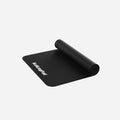
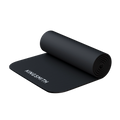
Three things can help. First, EVA and PET shock absorption used on our walking pads helps cushion each step. Second, a suitable treadmill mat can help reduce vibration and transmitted noise while also protecting the floor. Third, speed matters: walking generally produces less impact than jogging or running, so keeping to a comfortable walking pace can help reduce disturbance. If you are on an upper floor, especially in an older or converted property, choose a walking model rather than a running treadmill, use a suitable mat, and place the machine on a firm, level surface.
Yes, with two caveats that matter. First, ventilation: the motor housing on a slim pad sits close to the floor, and some models draw cooling air from underneath. Deep pile or a thick underlay can restrict that airflow and let dust build up around the motor compartment, which can cause a machine to get louder over time. On carpet, put a firm, protective mat underneath and vacuum around and under the unit monthly.
Second, stability: a soft carpet can let the frame settle unevenly, and an uneven frame can cause a belt to drift off-centre. A firm mat gives the frame a more stable surface to sit on and helps reduce belt tracking problems.
Practical points: on carpet, expect a slightly softer feel underfoot; check the belt alignment after the first week, because a new machine may need minor adjustments; and if you have long-pile carpet, use a firm, protective mat underneath to help keep the machine stable.
At 4 km/h, most adults take roughly 6,000–7,000 steps an hour, so 10,000 steps takes around 90–100 minutes; at 5 km/h, it is closer to 80–90 minutes. The exact time depends on your stride length. While working, a slower pace of around 1–2.5 km/h is generally more comfortable, so reaching 10,000 steps will take longer. You do not need to do it in one block. What works is stacking it onto tasks that do not need fine motor control: calls, video meetings where you are listening, reading documents and email triage. Typing accurately while walking can be harder at higher speeds, so the realistic pattern is to start with two or three 30-minute blocks at a comfortable pace across a working day, gradually increasing your walking time as you get used to it. This helps you build towards 10,000 steps without adding separate workout sessions to your diary.
Two setup details make the difference between doing this daily and giving up. Desk height: walking adds height under your feet, so a standing desk needs to be set higher than your normal standing position — set it, then check your elbows are at roughly 90 degrees and your shoulders remain relaxed. And shoes: walk in supportive trainers rather than barefoot or in slippers, especially for longer sessions, to provide cushioning and grip.
Four, stated plainly. One: the speed ceiling is real. A walking-only model typically stops at 6 km/h, and if you later want to jog, you may need a different machine — this is a potential regret, and the fix is to buy into the Hybrid tier (such as the R3 Hybrid+) if there is any chance you will want to run. Two: no incline on most walking-only models, which limits how much you can raise intensity once walking at 5 km/h becomes easy; the answer there is either a hybrid with more speed options or the G5i with powered incline, depending on your training goals. Three: deck width. At around 40–44 cm, these walking areas are sized for walking, and if you prefer more room for your natural stride, you may notice the constraint at anything above a brisk pace — the X218 offers a wider 510 mm running belt for that reason. Four: it is still a relatively heavy object. "Foldable" means it takes up less space in storage, not that it is weightless; if it needs to travel up stairs regularly, check the model's weight before you buy. What is not necessarily a disadvantage, despite being widely repeated: durability at walking speeds. A brushless motor operating within its rated limits is designed for regular use, although long-term durability also depends on proper maintenance and usage.
Match the model to how much of the day the belt will actually be moving, as well as your weight and walking needs. Light use — a couple of 20-minute blocks, one user under 90 kg: the C1 at £309 (22 kg, 220 lb capacity) or the Z1 at £319 (23 kg, 242 lb capacity) are affordable, lightweight options. If you are already on your feet all day, shorter walking sessions may be enough.
Regular daily use — two or more hours across a working day: consider the A1 Pro at £429, which offers a 300 lb capacity, the highest in the walking-only range, and folds to 12.9 cm. If you are mostly seated, start with shorter sessions and gradually increase your walking time rather than aiming for two hours immediately.
Heavier user or shared household: the A1 Pro's 300 lb rating and the R3 Hybrid+'s 265 lb capacity with a 440 mm walking belt give you different options.
Want a display and visual progress feedback rather than a basic walking pad: the R3 Hybrid+ (£669) and Z3 (£499) offer enhanced displays, with the R3 Hybrid+ also featuring a dynamic light bar. Want colour options: the C2 comes in white and black at £369.
The rule of thumb: choose a model with a maximum user weight comfortably above the heaviest user, and check the recommended usage and maintenance instructions before you buy.